
Newsletter Edition #348 [The Files Brief]
Readers,
Find below key resolutions, decisions that will be discussed starting today at the World Health Assembly.
We have this quick ready reckoner for those of you following the proceedings whether in-person or remotely. We hope you find this useful. (My colleague Shubhangi has pulled this together for you)
Geneva Health Files offers value to our readers who are experts in global health. Tracking global health policy-making in Geneva is tough and expensive, without institutional support. For six years, we have provided you with the information and tools that directly contribute to your work in the field. We rely on our readers who value news they can use.
By becoming a paying subscriber you make our work possible. Our subscribers contribute towards greater accountability in global health.
More from us as we cover the WHA.
Priti
Priti Patnaik, Founder & Publisher, Geneva Health Files
Feel free to write to us: genevahealthfiles@gmail.com ; Find us on BlueSky, Instagram and Linkedin.

The 79th World Health Assembly Agenda At Your Finger Tips
By Shubhangi Thakur
The 79th World Health Assembly begins in Geneva today and will run until May 23, 2026.
The annual meeting has, in some ways, already been framed by the declaration of Ebola as a Public Health Emergency of International Concern, a day before the commencement of the proceedings.
Apart from the official proceedings, there are scores of events around the Assembly. And plenty of behind-the-scenes action. It is understood that the week may also see some early nominations for the next Director-General of the WHO.
The meeting is also expected to witness a slew of political discussions, including on Palestine, Iran and Ukraine.
In a procedural and political read of the Assembly, Gian Luca Burci, Senior Visiting Professor of International Law at the Geneva Graduate Institute, laid out the plan for the week at an opening event held ahead of the meeting, organized by the UN Foundation and the Institute’s Global Health Centre.
CONTEXTUALISING THE ASSEMBLY
In his briefing, Burci highlighted the following:
● Agenda formally prepared by the Executive Board (EB), considered by the General Committee on Monday morning and submitted to plenary for adoption.
● Main groups of items in the agenda, organized along four pillars from General Programme of Work (GPW) for coherence:
1) New items proposed by Member States or DG, coming through the EB sometimes with a draft resolution or decision.
2) Statutory items (eg human resources and finance)
3) Recurring items from previous WHAs
4) Supplementary items proposed directly to the WHA (Taiwan)
5) Progress reports, considered only at WHA (committee B)
6) Global strategies and plans of action expiring within one year
Key Matters
● Governance issues
○ 18.2 Reporting on operational efficencies
○ 20.1 Reform of the global health architecture and the UN80 Initiative
● Political issues
○ Taiwan invitation as an observer
○ 14.4 Ukraine (WHA75.11 (2022))
○ 17.1 and 17.2 Palestine
○ 20.2 Communications of the United Nations Secretary-General as depositary of the Constitution of the World Health Organization
Programmatic Matters
● 13.3 Open-ended Intergovernmental Working Group on the WHO Pandemic Agreement
● 13.2 Implementation of the International Health Regulations (2005) including extension of the standing recommendations on mpox and COVID-19
● Also to consider:
○ Establishment and functioning of new IHR's governance
○ Process to appoint the Director-General
OFFICIAL SPEAK: WHA79
The agenda includes nearly 70 items and sub‑items.
A statement from the WHO listed key items:
Reforming the global health system
The Health Assembly will focus on the future of the global health architecture and decide whether to launch a new Member State-led process to reform the global health system, align with United Nations’ reform efforts, and strengthen coordination across actors.
Shaping health policy and responding to health emergencies
Member States will take decisions on major health policy frameworks, including the post‑2030 tuberculosis strategy, the strategy on the economics of health for all, global action plan on antimicrobial resistance, and on integrated emergency, critical and operative care.
Countries will consider decisions related to precision medicine, smart pharmacovigilance, reducing the burden of stroke, haemophilia and other bleeding disorders, as well as strengthening the WHO Global Code of Practice on the International Recruitment of Health Personnel, among others.
The Health Assembly will also examine the implementation of the International Health Regulations (2005) and WHO’s work in health emergencies.
Budget, finance and constitutional matters
Member States will address budget and finance matters, including the Results Report 2024-2025, and financing and implementation of the Programme budget 2026–2027. They will also review the status of collection of assessed contributions and consider constitutional matters regarding membership of WHO.
In a briefing document earlier this month, the WHO described the following agenda:
WHA79: Committee A
As many as 13 discussions are envisaged in Committee A
Provide health
(6 discussions)
Discussion: (The following sub-items will be taken together)
Item 11 Recommitting to accelerate progress towards malaria elimination
Sub-Item 12.3 Communicable diseases
• Immunization Agenda 2023
• Road map for neglected tropical diseases 2021-2030
• End TB Strategy (Decision)
Discussion: (The following sub-items will be taken together)
Sub-item 12.1 Follow-up to the political declaration of the third high-level meeting of the General Assembly on the prevention and control of non-communicable diseases
Sub-item 12.2 Mental health (Resolution and decision)
Sub-item 12.4 Universal health coverage (Resolution)
• Draft global strategy for integrated emergency, critical and operative care, 2026–2035 (Decision)
• Increasing availability, ethical access and oversight of transplantation of human cells, tissues and organs (Decision)
• Rare diseases
Discussion: (The following sub-items will be taken together)
Sub-Item 12.5 Primary healthcare
Sub-Item 12.8 Report of the Expert Advisory Group on the WHO Global Code of Practice on the International Recruitment of Health Personnel (Resolution)
Discussion: (The following sub-items will be taken together)
Sub-Item 12.7 Substandard and falsified medical products
Sub-Item 12.9 Draft updated global action plan on antimicrobial resistance (Decision)
Discussion: The following sub-items will be taken together:
Sub-Item 12.6 Health in the 2030 Agenda for Sustainable Development
Sub-Item 12.10 Harmonization of regulatory approaches, governance and standards for data, digital health and artificial intelligence in the health sector
Protect health
(5 discussions)
Discussion: Sub-Item 13.3 Open-ended Intergovernmental Working Group on the WHO Pandemic Agreement (Resolution)
Discussion: (The following sub-items will be taken together)
Sub-Item 13.1 Report of the Independent Oversight and Advisory Committee for the WHO Health Emergencies Programme
Sub-Item 13.2 Implementation of the International Health Regulations (2005)
The following sub-items will be taken together:
14.1 WHO’s work in health emergencies
14.2 Strengthening the evidence base for public health and social measures
Discussion: 14.3 Poliomyelitis
Discussion: 14.4 Implementation of resolution WHA75.11 (2022)
Promote health
(2 discussions)
Discussion: (The following sub-items will be taken together)
Sub.Item 15.1 Strengthening rehabilitation in health systems
Sub.Item 15.3 The health of Indigenous Peoples (Decision)
Sub.Item 15.4 Maternal, infant and young child nutrition
Discussion: (The following sub-items will be taken together)
Sub-Item 15.2 Well-being and health promotion (Resolution)
• Outcome of the WHO Commission on Social Connection
Sub-Item 15.5 Draft strategy on the economics of health for all (Decision)
WHA79: Committee B
11 discussions envisaged
On Wednesday 20 May at 14:30:
Discussion: (The following sub-items will be taken together)
Item 17 Health conditions in the occupied Palestinian territory, including east Jerusalem, and in the occupied Syrian Golan
Sub-Item 17.1 Health conditions in the occupied Palestinian territory, including east Jerusalem, and in the occupied Syrian Golan
Sub-Item 17.2 Health conditions in the occupied Palestinian territory, including east Jerusalem (Resolution)
Power and Performance
10 discussions envisaged noting that Member States will be invited to focus discussion on the PBAC report and recommendations of the PBAC
Discussion: (The following sub-items will be taken together)
Sub-Item 18.1 Results report 2024 (Programme budget 2024–2025: performance assessment) Financial report and audited financial statements for the year ended 31 December 2025 (Decision)
Sub-Item 18.2 Financing and implementation of the Programme budget 2026–2027
• Reporting on operational efficiencies
+ Sub-Item 18.14 Human Resources - document A79/21 Add.1 on WHO’s prioritization and realignment process in 2025‒2026
Discussion: (The following sub-items will be taken together)
Sub-Item 18.3 Status of collection of assessed contributions, including Member States in arrears in the payment of their contributions to an extent that would justify invoking Article 7 of the Constitution (Resolution)
Sub-Item 18.4 Special arrangements for settlement of arrears [if any]; and
Sub-Item 18.5 Assessment of new Members and Associate Members [if any]
Sub-Item 18.6 Amendments to the Financial Regulations and Financial Rules [if any]
Discussion: (The following sub-items will be taken together)
Sub-Item 18.7 Report of the External Auditor (Decision)
Sub-Item 18.8 Report of the Internal Auditor
Sub-Item 18.9 External and internal audit recommendations: progress on implementation
Sub-Item 18.10 Proposed amendments to the process for the selection of the External Auditor (Decision)
Discussion: (The following sub-items will be taken together)
Sub-Item 18.11 Prevention of sexual exploitation, abuse and harassment
Sub-Item 18.12 Governance reform
• Secretariat implementation plan on reform
Sub-Item 18.13 Update on the Infrastructure Fund
• Geneva buildings renovation strategy
• Update on information management and technology
Discussion: (The following sub-items will be taken together)
Sub-Item 18.14 Human resources: annual report (continued) (Resolution)
Sub-Item 18.15 Amendments to the Staff Regulations and Staff Rules
Sub-Item 18.16 Report of the International Civil Service Commission (Decision)
Item 19 Appointment of representatives to the WHO Staff Pension Committee
Item 20 Collaboration within the United Nations system and with other intergovernmental organizations
Discussion: (The following sub-items will be taken together)
Item 20 Collaboration within the United Nations system and with other intergovernmental organizations
Sub-Item 20.1 Reform of the global health architecture and the UN80 Initiative (Decision)
Discussion: Sub-Item 20.2 Communications of the United Nations Secretary-General as depositary of the Constitution of the World Health Organization (Decision)
Discussion: Item 22 Matters for information
Progress reports - Three discussions: (i) Provide Health; (ii) Protect Health & Power and Performance; and (iii) Promote Health.
Also from us:
 Priti Patnaik
 Priti Patnaik
 Priti Patnaik
 Priti Patnaik
 Priti Patnaik
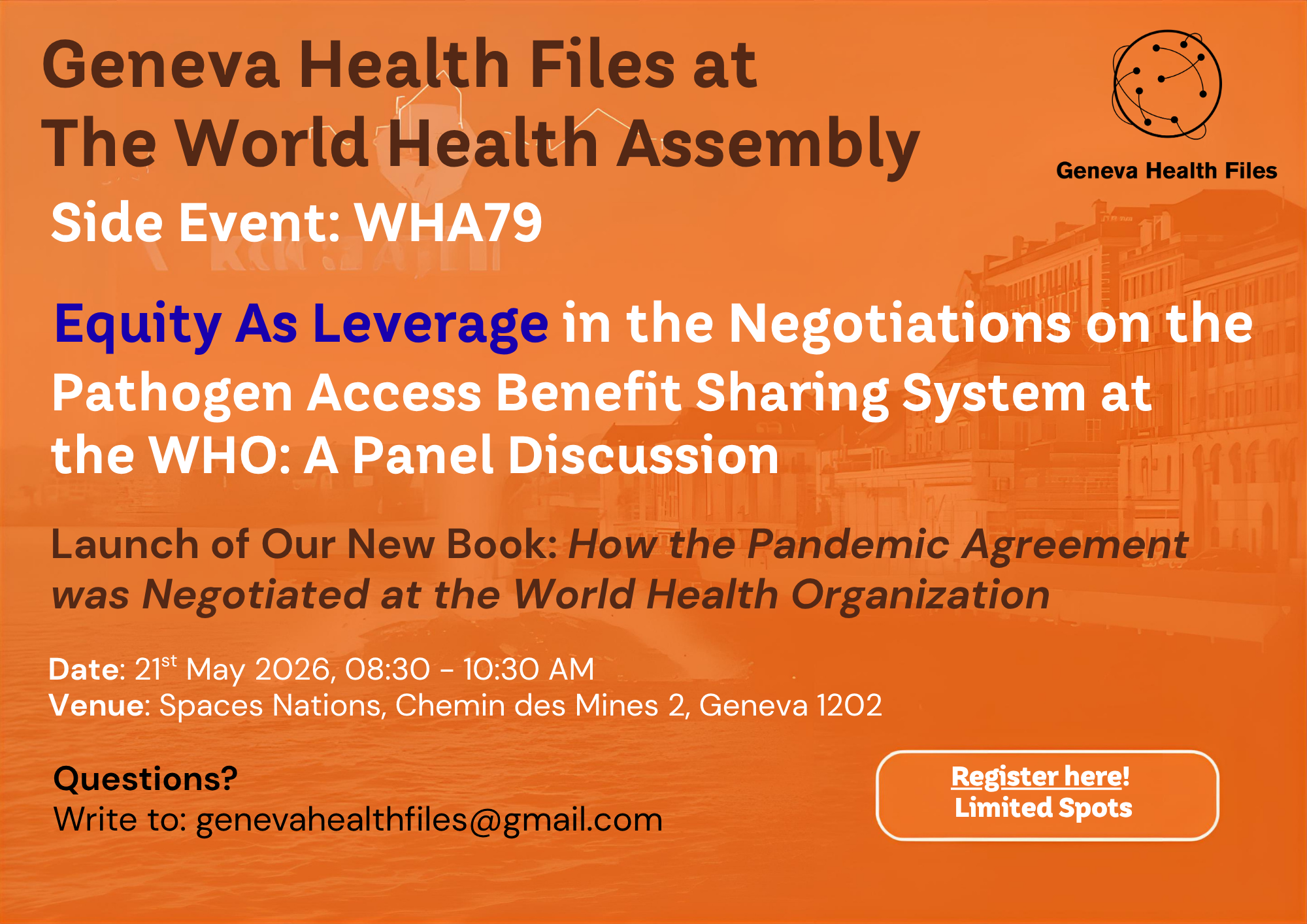
GHF WHA79 SIDE EVENT
Global health is everybody’s business. Help us probe the dynamics where science and politics interface with interests. Support investigative global health journalism.
 Priti Patnaik
![Sovereign Control Over Pathogen Information: The Design Crux of The Pathogen Access Benefit Sharing System at The WHO [IGWG8 Update]](https://storage.ghost.io/c/3e/27/3e275aa8-3271-4edb-ac7b-04dcacf8a053/content/images/size/w960/format/webp/2026/09/pexels-jan-van-der-wolf-11680885-38628465.jpg)


