
Newsletter Edition #378 [The Files In-Depth]
Readers,
In today’s edition we bring you an all-in-one edition covering the emerging contours of the ongoing election process at the WHO. (5,000+ words!)
This story, several of a series in the run up to the elections, discusses process, politics and candidates (so far).
We have not published speculative names on interested candidates so far. It was a conscious editorial decision. (Those of you who recognized our discretion, thank you!). So we discuss only nominated names as on August 31 when this story went live. We will continue to update and report, as new names surface in the election race.
Also check out below, an analysis on how the process has evolved over the years. (Heaven for nerds). My colleague Anjan Rosario brings his legal lens and distills it for our readers.
We will be following the WHO elections closely over the coming year and will be providing intelligence on behind-the-scenes dynamics to our readers. Scholars, activists, think tanks, or others, can reach out to collaborate with us for analysis, commentary and curating this significant transition in global health. Write to us: genevahealthfiles@gmail.com. Lets widen the dialogue!
Geneva Health Files offers value to our readers who are experts in global health. Tracking global health policy-making in Geneva is tough and expensive, without institutional support. For six years, we have provided you with the information and tools that directly contribute to your work in the field. We rely on our readers who value news they can use.
By becoming a paying subscriber you make our work possible and help us gather, report and synthesise global health intelligence.
Best,
Priti
Priti Patnaik, Founder & Publisher, Geneva Health Files
Feel free to write to us: genevahealthfiles@gmail.com ; Find us on BlueSky, Instagram and Linkedin.

I. GHF ANALYSIS
People, Process, Politics: The Election of the Director-General of The World Health Organization
By Priti Patnaik
Pia Mehdwan contributed to this story.
Global Public Health is a universal concern. As the leading and coordinating authority on health, the World Health Organization and its member states, embody this responsibility. The election for who leads the WHO is, therefore a significant process.
Locate this role in the reality of today: restructured, shrunk, and edged out by well-funded actors, and a political climate stacked against it, the institution is at cross-roads not unlike in the past. A new leader must lead from the front, get her or his hands messy with geopolitics, preserve the mandate and make it stronger. The election also takes place in the context of wider, yet-to-be-bold ideas for reforms in global health, and a significant transformation in the international order.
For an area as sensitive as health, and one with deep commercial interests, and increasingly one having strategic and security implications, there are plenty of views on what a new WHO leader should do, must do and can do. These lofty aspirations, and even optimism, are natural and required, but as the months roll on, they will also be tempered down by the realities of the terrain.
This story takes stock of the state of play in the proceedings that have just about begun. We reviewed documents, spoke to legal experts, diplomats, ambassadors and numerous long-time observers of the WHO.
THE TIMELINE
The Director-General (DG) is the World Health Organization’s chief technical and administrative officer, elected through a two-stage process in which the Executive Board nominates and the World Health Assembly appoints. The Board - made up of 34 technically qualified members elected by the Health Assembly - interviews and shortlists candidates. The final appointment is made by the full membership of 194 Member States by secret ballot.
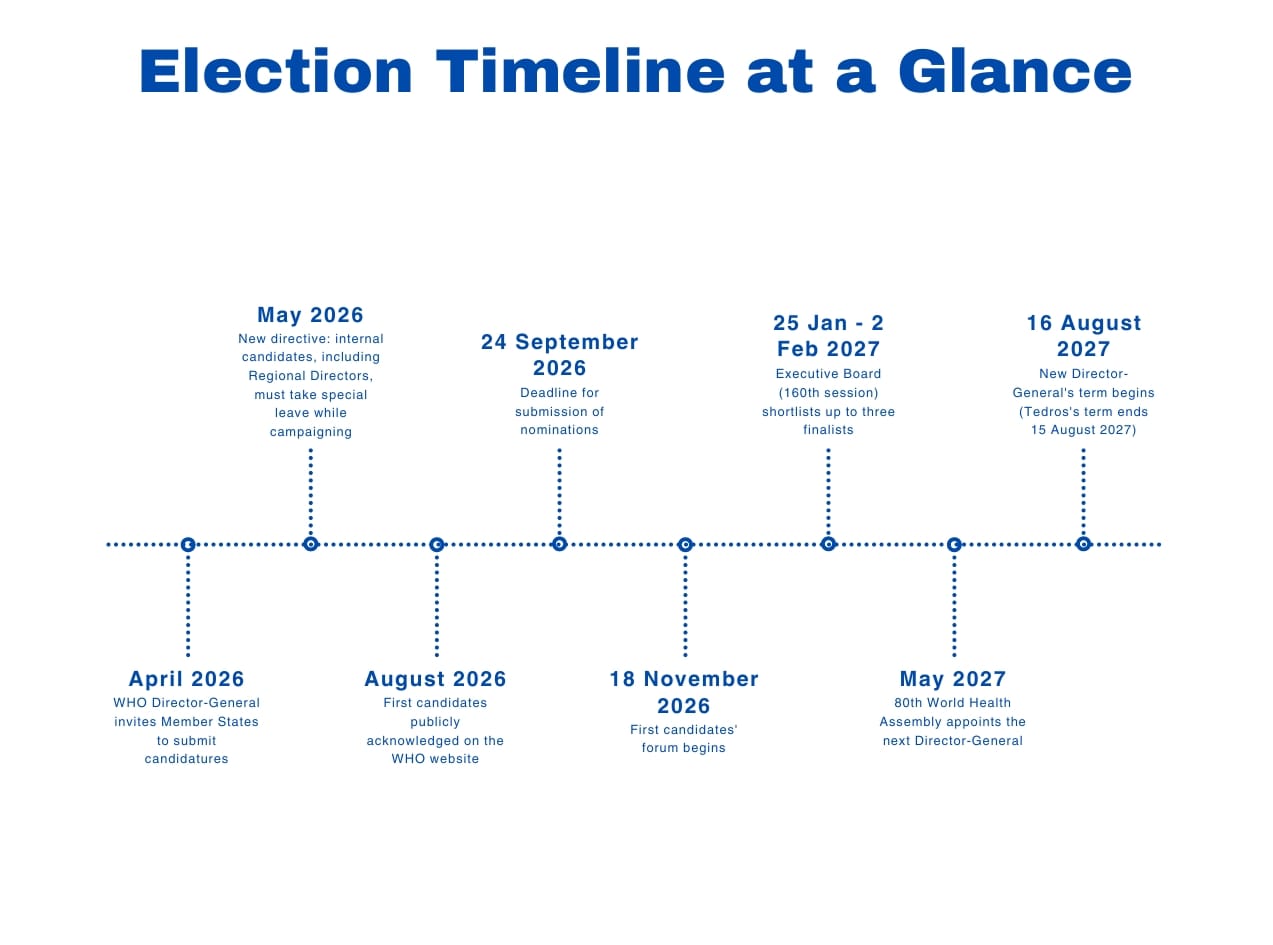
The current Director-General, Tedros Adhanom Ghebreyesus, began his second term on 16 August 2022, it concludes on 15 August 2027. Because a Director-General may only be reappointed once, DG Tedros cannot stand again, opening the first fully contested race since 2017.
A decade after WHO’s first African DG was elected in 2017, these elections are significant as well. What most changes the dynamics is that, for the first time in a decade, the shortlisting stage will involve a genuinely contested field. Tedros stood for his second term in 2022 as the sole candidate, so the Executive Board's nomination that year was largely procedural. The last election in which the board had to reduce a field of competing candidates to a shortlist was 2017.
The 2017 election was itself the debut of a substantially revised system. As the WHO’s own election-process FAQ set out at the time, the process had been “substantially revised since 2012,” with the key innovations including a Code of Conduct running through the whole process, electronic and live candidate forums, and, most consequentially, the possibility for the Health Assembly to appoint the Director-General from among up to three nominated candidates. While the Executive Board would still screen candidates and draw up a short list but the decisive choice now sat with the full membership rather than the board alone.
The full timeline and supporting papers sit in the WHO’s election documents. The procedural detail now sits codified in the WHO’s election handbook. (See detailed analysis in the next section.)
The 2027 race returns the board and the wider Assembly to the task of a “full-election” with a host of candidates in play.
- The current cycle began in April 2026, when the DG invited Member States to submit candidatures. The deadline for proposals is 24 September 2026.
- Candidates who are nominated then take part in a candidates’ forum, schedule to begin on 18 November 2026, at which Member States can question them directly.
- The Executive Board, at its 160th session in early 2027, will interview the contenders and nominate up to three candidates for consideration by the Health Assembly.
- The appointment of the next DG will take place at the 80th WHA in May 2027, with the successor taking office on 16 August 2027.
- The 34-member Executive Board is composed of the following members:
AFRICA:
CABO VERDE (2025-2028), CENTRAL AFRICAN REPUBLIC (2025-2028), CÔTE D’IVOIRE (2026-2029), GUINEA (2026-2029), MOZAMBIQUE (2026-2029), SOUTH SUDAN (2026-2029), ZIMBABWE (2024-2027)
AMERICAS
CHILE (2024-2027), COSTA RICA (2024-2027), EL SALVADOR (2025-2028), HAITI (2025-2028), PANAMA (2025-2028), SURINAME (2026-2029)
SOUTH-EAST ASIA
BHUTAN (2026-2029), NEPAL (2025-2028), THAILAND (2024-2027),
EUROPE
BULGARIA (2024-2027), GEORGIA (2026-2029), ISRAEL (2024-2027), NORWAY (2024-2027), POLAND (2024-2027), SERBIA (2025-2028), SPAIN (2025-2028), UNITED KINGDOM OF GREAT BRITAIN AND NORTHERN IRELAND (2026-2029)
EASTERN MEDITERRANEAN
EGYPT (2025-2028), KUWEIT (2026-2029), LEBANON (2024-2027), SAUDI ARABIA (2025-2028), SOMALIA (2024-2027)
WESTERN PACIFIC
BRUNEI DARUSSALAM (2024-2027), CHINA (2026-2029), JAPAN (2025-2028), REPUBLIC OF KOREA (2024-2027), SOLOMON ISLANDS (2025-2028)
THE CANDIDATES
There are four prospective, nominated candidates, when this story went to print. We already wrote about them here. Briefly:
Hanan Balkhy - Saudi Arabia
A Saudi physician, Hanan Balkhy has served as WHO Regional Director for the Eastern Mediterranean since 1 February 2024; the first woman in the role, overseeing WHO’s work across 22 countries and territories serving some 745 million people.
Hanan Mohammed Al-Kuwari - Qatar
Hanan Mohammed Al-Kuwari is a Qatari health leader. She served as Qatar’s Minister of Public Health from January 2016 to November 2024, and was subsequently appointed Advisor to the Prime Minister of Public Health Affairs.
Hans Henri P. Kluge - Belgium
Hans Henri P. Kluge, WHO Regional Director for Europe, became the third candidate to enter the race. Kluge, a physician, joined WHO’s European office in 2009, led its Division of Health Systems and Public Health for roughly a decade, and became a Regional Director on 1 February 2020. He was reappointed to a second term from 1 February 2025.
Budi Gunadi Sadikin - Indonesia
Budi Gunadi Sadikin, Indonesia’s Minister of Health since December 2020. He is not a physician but a former banker and engineer. As health minister he led a large-scale reform of Indonesia’s health system after COVID-19.
NEW RULES REGIONAL DIRECTORS MUST PLAY BY
According to WHO, the following rules apply:
All staff have been instructed that WHO functions must be clearly separated from any campaign activities. In practice, this means that a staff member may campaign only while on leave.
Internal candidates will be placed on leave to ensure a clear separation between their campaign activities and WHO’s functions. This requirement applies also to elected officials, such as Regional Directors. Leave will be applied from the date of the acknowledgment as prospective candidate. WHO reserves the right to place staff on leave before this in the interests of the Organization, for example in the event of an earlier public and official announcement of a candidacy by a Member State.
Internal candidates will first exhaust their accrued annual leave. Once the accrued annual leave is exhausted, internal candidates will be placed on special leave with half pay until the closure of the 160th session of the Executive Board in 2027. If nominated by the Board, internal candidates will then be placed on special leave with full pay after the closure of the Board’s session and until the closure of the Eightieth World Health Assembly in 2027.
We had reported earlier that the Assembly in May had adopted the new process: "...In accordance with Staff Rule 650.2 and paragraph IV.4 of the Code of Conduct for the election of the Director-General of the World Health Organization,7 the Director-General intends to place internal candidates on special leave to ensure a clear separation between their campaign activities and WHO’s functions".
As a result, the two regional directors in the race have been placed on special leave. See below.


