![Global Health: Down But Not Out [GUEST ESSAY]; GHF Jobs Scanner](/content/images/size/w1280/format/webp/substack-post-media-s3-amazonaws-com/public/images/2c6cb6c7-c987-4b20-b21c-7563d3f868b9_4900x3266.jpg)
Hi,
Global health financing has undergone transformation, for the worse, in 2025. But in the lives of institutions, navigating crests and troughs of financing are a fact.
In today’s edition, I am pleased to bring you a guest contribution from Daniel Thornton, who has worked closely on financing matters both at Gavi - The Vaccine Alliance, and at the World Health Organization. For our readers, he brings the insider perspective on global health financing across agencies. We hope you find this useful.
Also below, check out our monthly jobs board.
Watch out for more from us in the coming days as Geneva steps into its busiest months. Next week negotiations at the WHO will resume, followed by preparations for its annual Executive Board.
This is a fine time to , if you haven’t so far. Thank you for reading.
Support public interest global health journalism, become a paying subscriber. Tracking global health policy-making in Geneva is tough and expensive. Help us raise important questions, and in keeping an ear to the ground. makes this possible.
Gratitude to our subscribers who help us contribute to greater accountability in global health.
More soon!
Best,
Priti
Feel free to write to us: patnaik.reporting@gmail.com or Follow us on Twitter: @filesgeneva

I. GUEST ESSAY
Global Health: Down But Not Out
By Daniel Thornton
Thornton is a former chief of staff at Gavi, and has been responsible for fundraising at Gavi and WHO.
It is hard to make sense of changes when you’re in the middle of them. But it feels like international development and global health are experiencing changes on a scale not seen since after the Second World War when the United Nations was established, or during decolonisation in the 1950s and 1960s, or in the post-Cold War period of the Millennium Development Goals and the associated growth in Official Development Assistance (ODA).
The difference now is that, institutions and programmes are being dismantled rather than built. Funding for international development is being hit by two related issues. First, having risen from $168 billion in 2019 to its peak of $223 billion in 2023[1], ODA is now being cut. It fell 6% in 2024 with a bigger fall in 2025 and more to follow, as political sentiment turns and donors grapple with the fiscal impacts of the pandemic and the Ukraine conflict. Secondly, the focus of ODA has shifted with nearly 15% spent on refugees in wealthy countries rather than on supporting the development of lower income countries.
The shift in priorities is hitting global health particularly hard. At the height of the pandemic in 2021, more than 18% of ODA went to health, whereas in 2023 (the most recent figure available) this fell to 10.3%. This is a lower proportion than in 2019, when nearly 12% of ODA went to global health.
A longer perspective on funding for global health agencies
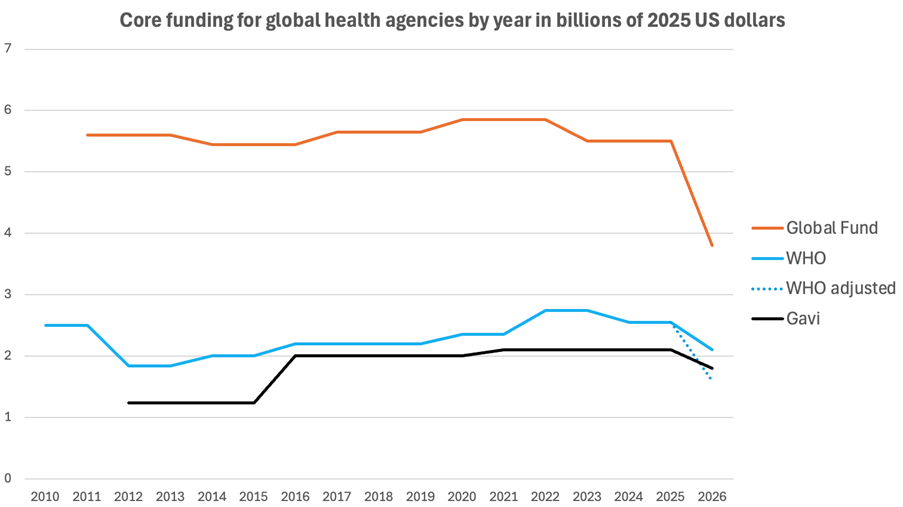
These shifts can be observed in WHO, and the two big global health funding agencies, the Global Fund to Fight AIDS, Tuberculosis, and Malaria, and Gavi. To see behind the headlines, the funding and budgeting cycles of the different agencies (two years at WHO, three years at the Global Fund, and five years at Gavi) need to be taken into account, as well as US dollar inflation, which has been nearly 50% since 2010. Counting in 2025 dollars, the Global Fund had fairly stable funding of $5.5bn-$5.9bn a year since 2010, until the latest replenishment which (subject to further pledges) implies a budget of $3.8bn a year until 2028. This represents a 35% reduction from the Global Fund’s peak at the 2019 replenishment.
Gavi’s annual funding (in 2025 dollars) has also been fairly stable from 2016, at $2bn-2.1bn, until the current replenishment which implies an annual budget of $1.8bn.[2] This represents a 14% reduction from Gavi’s peak at the 2020 replenishment. Gavi is reducing staff by 32%[3] and the Global Fund is also making reductions though as most of their spending is on commodities - vaccines in the case of Gavi, and drugs in the case of the Global Fund - and supporting countries, this is where the biggest reductions will come. The Global Fund has already announced it will reduce its programmes to tackle AIDS, TB, and malaria by $1.4bn.[4]
WHO’s core funding has fluctuated more. Looking only at the base part of the programme budget (i.e. the budget that is controlled by WHO, and is not for emergency campaigns), WHO’s annual funding since 2010 has varied (again in 2025 dollars) between $1.8bn and $2.8bn, with the peak in 2022-2023. Following the US withdrawal and reductions by other donors, WHO has significantly reduced its budget for 2026-2027 based on expected annual funding of $2.1bn. However, $500m per year remains unfunded even with the smaller budget (this is shown as “WHO adjusted” in the chart). WHO continues to fundraise to fill this gap but this remains a serious challenge. Most of WHO’s base budget goes on staff costs: headcount reductions of a quarter have been announced, and more are likely to follow.
Putting spending on international development in perspective
While the UN system of which WHO is a part is often described as vast, it is tiny compared to the public sectors of most countries. Around 130,000 people are employed in the UN and its agencies. Taking two medium sized countries, the UN has 2% of the public sector workforce of the UK, or 15% of Tanzania, whereas the UN needs to work with and in every country on the planet to support peacekeeping, cooperation between states, and international development. And the UN is reducing its staff by perhaps 20%.
Even before the recent reductions, spending on international development was small compared to the big goals that world leaders have set themselves. Last year OECD countries spent 0.34% of their GNI or $214 billion on ODA – with the aim by 2030 of amongst other things reducing under five child mortality (60 countries are currently off track) and maternal mortality to 70 deaths per 100,000 live births (the current figure is nearly 200). None of these targets has been reduced along with ODA budgets.
What should the response be to the growing gap between resources and ambitions?
A recent paper in Nature provides a helpful framework.[5] It rightly urges agencies to avoid doing things globally that can be done locally. This makes sense because local capacity is essential for development, because controls from abroad are expensive for donors, organisations, and countries, and because we have seen recently how damaging it is when international funding is suddenly withdrawn. The world has changed since the UN, Gavi, and the Global Fund were established – traditional donor countries make up a smaller part of the world economy, and many lower income countries now have capacity to do things for themselves which used to depend on international agencies. And of course country leaders have intensified their calls for greater local control having experienced vaccine shortages during the pandemic and the rapid dismantling of donor funded health programmes.
For the UN, devolving decision-making is made harder because 85% of its funding is earmarked to particular projects. This means that project goals, methods, and sometimes providers are set as part of project grants – the opposite of local leadership. WHO is in a slightly better position than some other parts of the UN given its success in increasing assessed contributions – membership fees for governments which are fully flexible – including a 20% increase at the Health Assembly in 2025, and an increase in flexible funds during its Investment Round. But the problem remains: if donors want the agencies they fund to adapt to the new world and facilitate country leadership, they should improve the quality of that funding by making it flexible.
For those working in global health agencies, the pace of change has been bewildering. In 2025 the focus was on organigrammes rather than the mission, and staff morale is low.
This new year is the time to remind everyone why these institutions exist. For Gavi and the Global Fund this means tackling diseases which otherwise will spread around the world, using pooled funding rather than fragmented bilateral budgets so markets can be shaped, and working with governments and civil society to reach marginalised people. For WHO, supporting these efforts through its country presence, as well as acting as the parliament for global health, advising governments, and promoting science. Though for global health much has been lost, vital work remains.
[1] Figures in constant 2023 dollars. https://www.oecd.org/en/topics/sub-issues/oda-trends-and-statistics.html
[2] These figures exclude income for COVAX, although the most recent replenishment includes some funds left over from COVAX.
[3] See slide 13: https://newsletter.genevahealthfiles.com/content/files/www-gavi-org/sites/default/files/board/minutes/2025/3-4-december02---ceos-report-incl-collaboration-with-partners-and-gavi-leap-update---ppt.pdf
[4] https://www.barrons.com/news/global-fund-slashes-grants-already-awarded-fearing-funding-shortfall-59a0923b
[5] Rasanathan et. al., Nature Medicine, 11 September 2025 https://www.nature.com/articles/s41591-025-03936-9

II. GHF JOBS BOARD
Senior Level
- WHO Academy: Director, WHO Academy
Application Deadline: 15th of January 2026
Placement: Lyon - WHO: Director, Communications
Application Deadline: 15th of January 2026
Placement: Geneva
Mid Level
- UK Health Security Agency: Consultant in Public Health Global - IHR Strengthening Project
Application Deadline: 23rd of January 2026
Placement: London, Birmingham, Leeds or Liverpool - Clinton Health Access Initiative: Associate Director, Artificial Inteligence (AI) Programs Lead
Application Deadline: NA
Placement: United States - International Rescue Committee (IRC): Consultoría Médica
Application Deadline: 1st of February 2026
Placement: Ciudad Juarez - Vital Strategies India: Communication Manager
Application Deadline: NA
Placement:
Delhi - Médecins Sans Frontières (MSF): Humanitarian Advocacy Officer (w/m/d)
Application Deadline: 20th of January 2026
Placement: Berlin - IOM: Migration Health Program Coordinator (P)
Application Deadline: 15th of January 2026
Placement: Cotabato City
Junior Level
- United Nations Foundation: Intern, Global Health
Application Deadline: NA
Placement:
Washington - Fondation Botnar: Junior Project Manager Communications (80-100%)
Application Deadline: 20th of January 2026
Placement: Basel
We hope to hear from organizations and companies looking to share their open positions or assignments. Our readers include experts across global health, and we are keen on sharing our assiduously built community to help make connections. The idea is to showcase few but meaningful roles in global health anywhere in the world.
Looking to recruit a consultant or advertise a position? Reach us at genevahealthfiles@gmail.com with “GHF Jobs Scanner” in the subject line
 Priti Patnaik
III. WHAT WE ARE WATCHING
- WHO Intergovernmental Working Group Fourth Resumed Session: PABS Annex [January 20-22]
- WHO Programme, budget and administration committee PBAC43: January 28
- WHO Executive Board EB158: February 2-7
IV. HEADLINES & MORE FOR GLOBAL HEALTH GEEKS
- Withdrawing the United States from International Organizations, Conventions, and Treaties that Are Contrary to the Interests of the United States: The White House
- Dismantling the American Research Enterprise: Medpage
- ‘Unhinged’ or savvy? Meet Li Chenggang, who leads China’s trade talks with the US: Reuters
- Nestlé’s credibility questioned as formulas recalled in 60+ countries over contamination risk: IBFAN
- Dear Donald Trump: A letter from Nature on how to make science thrive: Nature
- Trade between EU member states is slowing, data shows: Financial Times
- Wellcome Trust builds cash pile as it warns on record high equity markets: Financial Times
Also from us:
Priti Patnaik Priti Patnaik
Global health is every body’s business. Help us probe the dynamics where science and politics interface with interests. Support investigative global health journalism.
![Leading The World Health Organization: Challenges & Opportunities Ahead For A New Director-General [GUEST ESSAY]](/content/images/size/w960/format/webp/public/images/d7c0b56d-fde9-4a7a-8c06-4fde7dcc07cc_8192x5461.jpg)


